Ordering custom key tags looks like a one-number decision: count your rooms and buy that many. In practice a room needs more than one tag, the front desk needs a working reserve, and tags disappear steadily over a year, so an order sized to the room count alone runs short within months and forces an early reorder at a fresh setup charge. Sizing the order properly is simple arithmetic once you separate it into three parts: the tags each lock needs, the spare pool behind the desk, and a buffer for the loss you know is coming. Here is how to work through each one.
Start with tags per lock, not per room
The base of any order is the number of usable tags a room needs to operate, and for most properties that is at least two per lock rather than one. One tag rides with the guest; the second stays behind the desk so housekeeping, maintenance, or a locked-out guest is never waiting on the only key in the building. If you run a genuine master-and-guest system, you may keep more, but two issued tags per room is a sound floor for planning. That single choice doubles the obvious number: a forty-room motel is planning around eighty issued tags before spares or losses enter the picture. Skipping this step is the most common way an order comes up short, because the room count feels like the answer and it is only the starting point.
The front-desk spare pool
Beyond the tags actively assigned to locks, a working property keeps a small reserve of blanks ready to swap in the moment a guest returns a bent, cracked, or illegible tag. Without that pool, every damaged tag means either issuing a room with a single key or waiting on a reorder, and neither is acceptable at check-in. A reserve of roughly a quarter of your room count is a reasonable planning figure for a stable operation, scaled up if your property is large or your turnover is high. The reserve is not waste; it is the difference between fixing a key problem in thirty seconds and apologizing to a guest. Treat it as a permanent line in the order rather than an afterthought.
Planning for the loss you know is coming
Guests walk off with tags, tags crack in pockets, and a percentage vanishes every year no matter how the property is run. The mistake is pretending the rate is zero and reordering in a panic when the spare drawer empties. Instead, fold a replacement buffer into the first order so you are not back at the setup charge within a quarter. The chart below breaks a sample order into its three components across property sizes, using a modest first-year buffer on top of the issued tags and the spare pool. The exact percentages are assumptions you should replace with your own, but the structure holds at every size: the issued tags are the bulk, the spare pool is a steady slice, and the buffer keeps you off an early reorder.
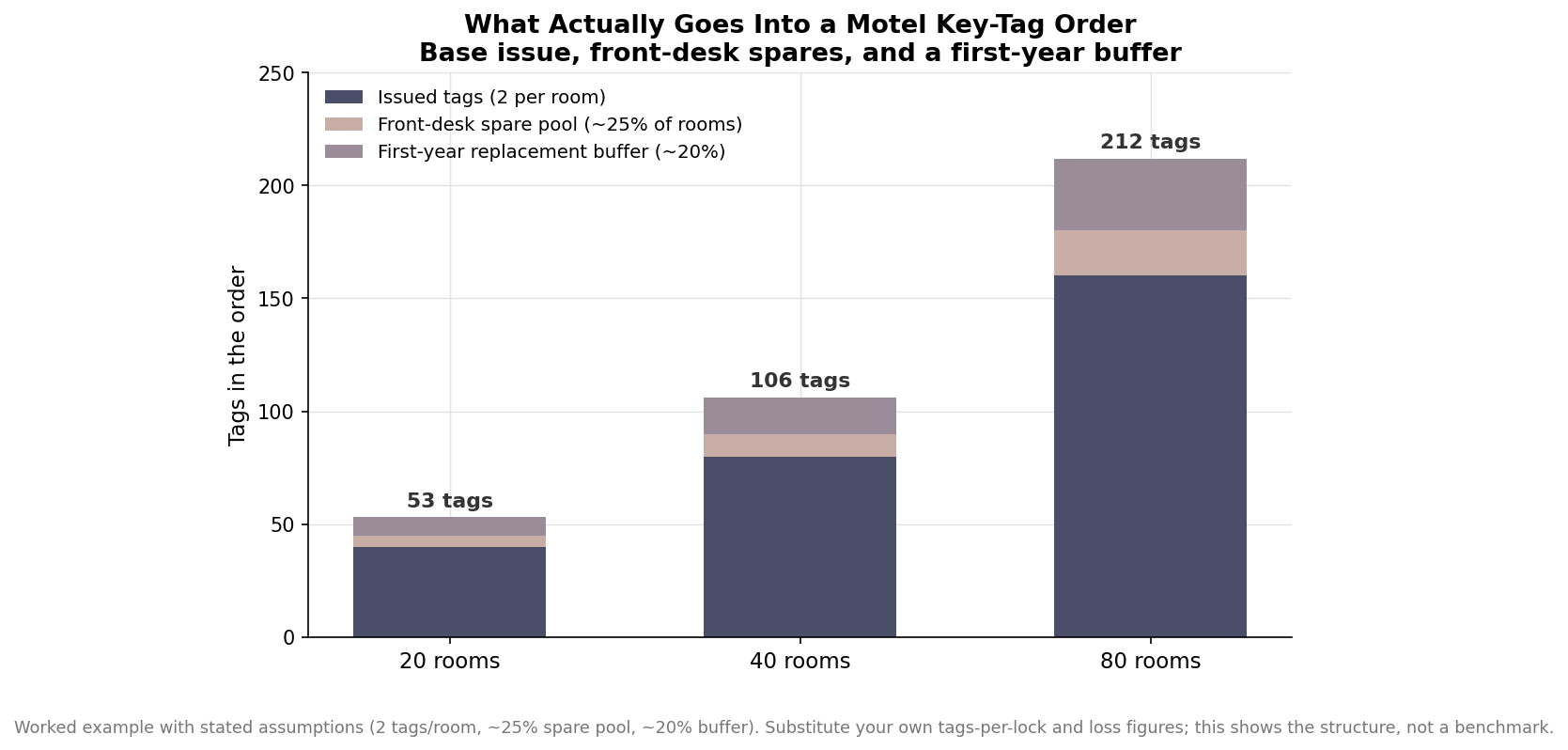
The arithmetic is worth doing explicitly because bulk pricing rewards it. Most custom tag runs carry a one-time setup or die charge that is spread across the quantity you order, so buying a sensible year of tags in a single run costs far less per tag than two rushed orders three months apart. The buffer is not just operational insurance; it is usually the cheaper way to buy.
How the loss rate swings your annual reorder
Once you are running, the number that governs your reorder cadence is the annual loss rate, and it is entirely property-specific. A quiet extended-stay motel with regulars may lose a handful of tags a year, while a busy roadside property with heavy nightly turnover loses far more. The second chart shows how a single forty-room example behaves as that rate climbs: at a low loss rate the yearly replacement is a small top-up, and at a high rate it becomes a meaningful reorder in its own right. The relationship is linear and easy to plan around once you know your own number.
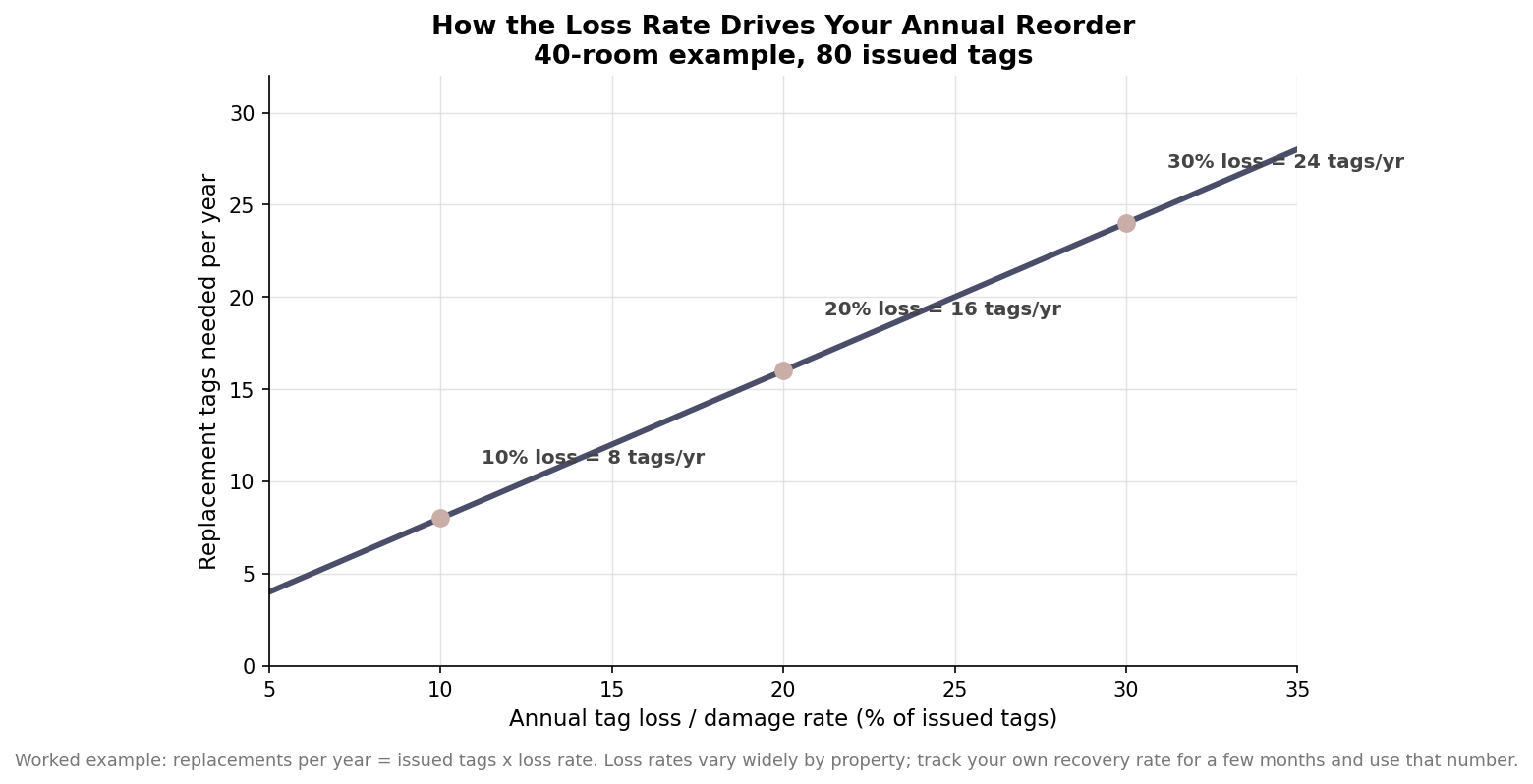
Finding your rate takes almost no effort. Count the tags you actually replace over two or three months, annualize it, and divide by your issued-tag count. That percentage is worth more than any industry average, because loss is driven by your guest mix and your front-desk habits, not by a benchmark. Track it once and every future order is a calculation rather than a guess.
Timing, minimums, and reorders
Two practical constraints shape the final quantity. First, custom tags usually carry a minimum order and a setup charge, so if your true annual need sits just below a price break, rounding up to the next tier often lowers your cost per tag while handing you extra buffer for free. Second, artwork and production take time, commonly in the range of one to three weeks from approved proof depending on material and decoration, so a property that reorders only when the spare drawer is empty is already weeks behind. Set a reorder point instead: when the spare pool drops to a defined level, place the next run. That single habit converts key-tag supply from a recurring scramble into a predictable line item.
Put the three parts together and the order almost writes itself. Take your room count, multiply by the tags each lock needs, add a front-desk reserve sized to your turnover, and add a replacement buffer based on your own tracked loss rate. Order that quantity in one run to earn the volume price, set a reorder trigger, and you will neither overspend on tags that sit in a drawer for years nor run short in the middle of a busy season. The math is small; the payoff is never being the property that hands a guest the only key to their room.