Most of the attention in a custom motel key tag goes to the tag itself, the shape, the finish, the room number stamped on the front. The small piece of hardware that connects it to the key gets almost none, right up until it fails. A ring that opens on its own drops a key behind a dresser; a clasp that wears out mid-season leaves the front desk fishing tags out of a drawer. The attachment is a real specification decision, and the four common options pull in different directions on three things that matter to a property: how securely they hold, how easily staff can add or remove a key, and how much they cost at bulk.
The split ring is the default for a reason
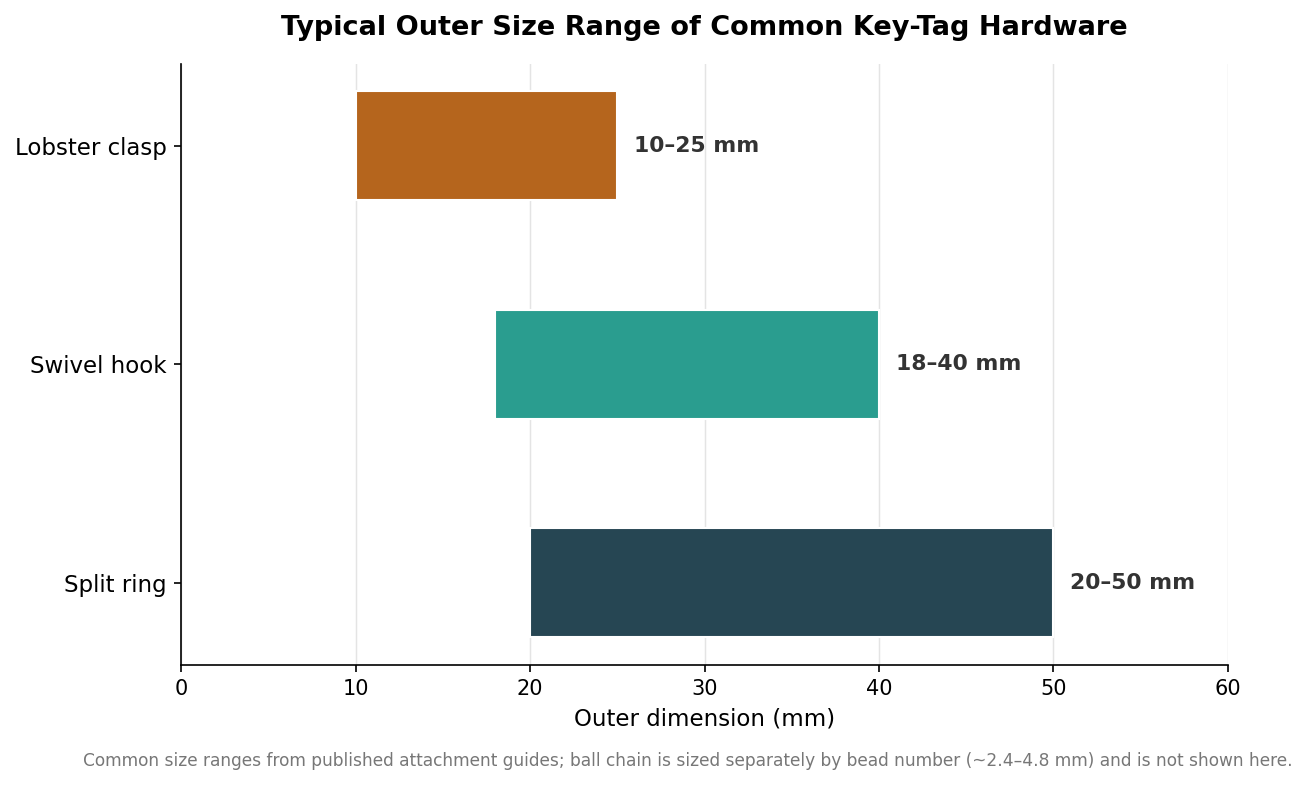
The flat coiled split ring is the workhorse of key hardware because it has no moving parts to fail. Nothing springs, latches, or wears; the key simply cannot come off unless someone deliberately works it around the coil. Published attachment guides put common split-ring diameters anywhere from about 20 millimeters up to 50 millimeters and larger, with the bigger sizes making room for several keys at once. The same feature that makes it secure makes it slow: adding or removing a key means prying the coil open with a fingernail or a tool, which is a minor annoyance once and a real one if you rekey rooms often. For a motel where a tag is assigned to a room and stays put for months, that tradeoff is exactly right.
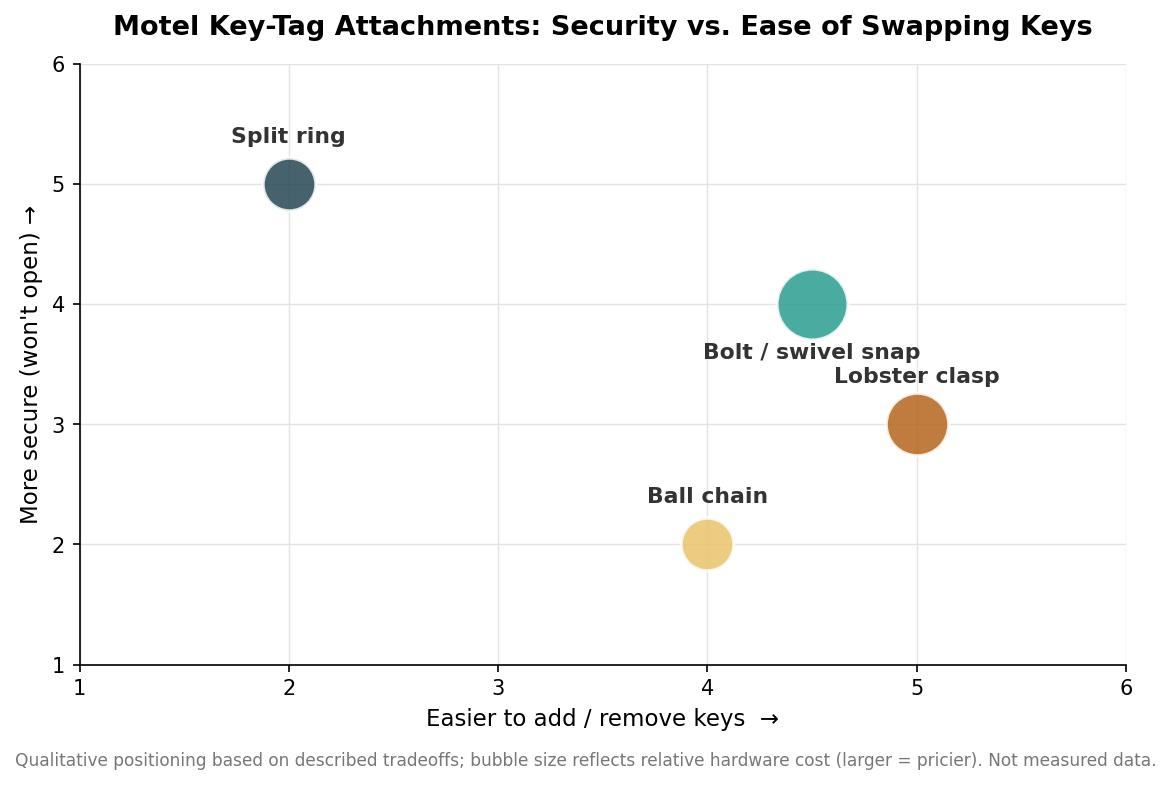
The positioning above is a qualitative map rather than measured data, but it captures the shape of the decision. The split ring sits high on security and low on swap-speed; the other three trade some holding power for the convenience of getting keys on and off quickly. Where your property lands depends less on which hardware is objectively best and more on how often your keys move between rings.
Ball chain: the vintage look with a practical streak
Ball chain is the hardware most people picture on a classic motel fob, and it earns its place beyond nostalgia. Because it connects with a simple bead-and-coupling, staff can lengthen a chain, shorten it, or re-link a tag in seconds without any tool. It is inexpensive at volume and forgiving to work with. The tradeoff is security: the coupling that makes it easy to open also makes it easier to pull apart under stress, so it holds a light tag reliably but is not what you want carrying a heavy ring of maintenance keys. Ball chain is sized by number rather than by loop diameter, with common beads running roughly 2.4 to 4.8 millimeters across, and heavier bead numbers give a sturdier chain. It suits display-style tags and situations where the tag itself, not the load of keys, is the point.
Swivel and bolt snaps for keys that move around
Swivel hooks and bolt snaps are built for hardware that gets clipped on and off frequently. A spring-loaded gate opens with a thumb, and a 360-degree swivel joint keeps the tag from twisting the way a fixed ring does. Guides list typical sizes from about 18 to 40 millimeters and rate them well for heavier loads, which is why they show up on valet tags, loaner keys, and any key that passes through several hands in a day. They cost more than a plain ring or a length of chain, and the spring is one more part that can eventually tire, but for a property that hands the same physical key to different rooms or vehicles, the speed of a one-handed clip pays for itself.
Lobster clasps trade toughness for convenience
The lobster clasp is the smallest and most fashion-oriented of the group, commonly running 10 to 25 millimeters. Its appeal is a very easy one-handed operation and a clean, finished look that reads more like a retail accessory than back-office hardware. The catch is durability: the fine spring mechanism that makes it convenient also weakens over time, and under the constant handling of a front desk it will fatigue faster than a split ring that has nothing to wear out. A lobster clasp is a good choice when the tag doubles as something guests notice and appreciate, or on lighter-use keys, and a weaker one where a key is grabbed, dropped, and re-hung dozens of times a day.
Match the hardware to how your keys actually move
The cleanest way to choose is to picture the life of the key rather than the look of the tag. If a tag is assigned to a room and rarely comes apart, the split ring wins on security and cost, and its awkward swap almost never comes up. If staff re-link, lengthen, or rotate tags regularly, ball chain removes the tool and the friction, as long as the key load stays light. If the same key is clipped on and off through the day, a swivel or bolt snap earns its higher price in saved seconds and fewer twisted tags. And where the tag is part of the guest impression, a lobster clasp looks the part on lighter-use keys. It is worth ordering a small sample with your intended hardware before committing a full run, because the difference between a ring that quietly does its job for years and a clasp that wears out by peak season is decided entirely by this one inexpensive part.
Leave a Reply